Why didn’t Mohamed Salah choose Saudi Arabia? / How Saudi football is restructuring its economy, from buying stars to building a sports industry.
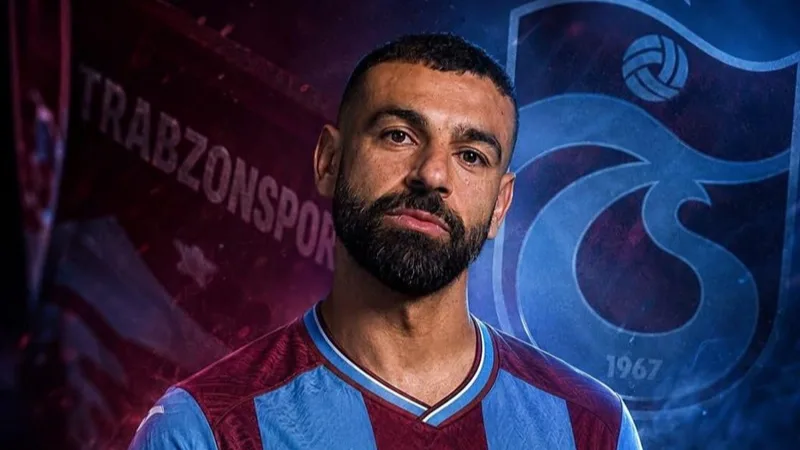
Mohamed Salah, the 34-year-old Egyptian star whose name has been linked to major Saudi clubs several times in recent years, has finally chosen to move to Turkish football after his time at Liverpool ended. But why didn’t Salah go to Saudi Arabia?
According to a sports economics platform, citing Trade News, Mohamed Salah’s recent move to Turkey’s Trabzonspor is one of the most unexpected events in the summer 2026 transfer window. The 34-year-old Egyptian star, whose name has been linked to major Saudi clubs in recent years, has finally chosen Turkish football after his time at Liverpool ended. According to Reuters, Salah has signed a two-year contract with Trabzonspor, earning 17 million euros annually. The contract includes not only salary but also benefits such as a 20% share of commercial goods sales bearing his name and performance bonuses.
Meanwhile, a question has arisen in the media and among sports fans: why did a player of Salah’s commercial and sporting stature not join the Saudi league at a time when Saudi Arabia has become one of the world’s largest investors in football? The answer should therefore be examined at two levels: first, Salah’s economic and professional decision, and second, the change in Saudi Arabia’s football economic model.
Did Saudi Arabia not want Salah?
The fact that Salah has moved to Turkey does not necessarily mean that Saudi clubs were unwilling to pay his desired salary. Meanwhile, credible sources have published different reports on the amount of Saudi Arabia’s possible offers to Salah, but no definitive and official figure has been announced by the Saudi club or Salah himself. Therefore, the claim made by some media outlets that “Saudi Arabia no longer had the ability or willingness to pay Salah’s contract” cannot be accepted as a definite reality.
What is certain is Salah’s choice of Trabzonspor. His contract also shows that the issue was not just about fixed salary, but also about commercial rights and a share of revenues related to the player’s personal brand. This is very important from a sports economics perspective, because Salah is a global commercial and media asset. Therefore, his decision could be a combination of salary, sporting role, media market, personal brand, sporting competition, and living conditions.
Saudi Arabia has money; but the model of spending money has changed
From another perspective, if we want to examine the reason for the change in Saudi Arabia’s football behavior in the transfer market, we should not start with “lack of money”; because Saudi Arabia’s Public Investment Fund (PIF) remains one of the world’s largest investment players and adopted a new strategy for the period 2026-2030 in April 2026. In this strategy, the fund emphasizes increasing financial returns, investment efficiency, greater private sector participation, and creating competitive ecosystems.
The fund also announced that its assets under management have increased from $150 billion in 2015 to over $900 billion, and that it has invested more than $199 billion in Saudi domestic projects between 2021 and 2025. Therefore, what is happening in Saudi football is more of a part of a larger change in Saudi Arabia’s investment model than a retreat from sports.
In the first stage, the goal was to expose Saudi football to the world as quickly as possible by injecting huge amounts of capital; and in this regard, the arrival of Cristiano Ronaldo, Neymar, Benzema, Mane, Mahrez and other stars could be analyzed exactly within this framework. But the next stage is the country’s strategy to build a sustainable economic sports industry.
Saudi Arabia’s shift from “buying players” to “building a sports ecosystem”
Some experts believe that the importance of Saudi Arabia’s new strategy can be seen in the country’s official policies; where the Saudi Ministry of Sports has been pursuing a project to invest in and privatize clubs since 2024. This project has two main paths: transferring ownership of clubs to development companies and institutions, and offering some clubs for privatization. In 2024, the Council of Ministers also approved a privatization document for 14 sports clubs.
A very important example of this also occurred in 2026, when the Saudi Public Investment Fund transferred 70% of Al-Hilal Club to Kingdom Holding Company. The value of Al-Hilal in this transaction was announced to be about 1.4 billion Saudi riyals, and the fund said that this transfer was made with the aim of achieving returns, freeing up asset value, and reallocating capital in the Saudi economy.
Therefore, if Saudi Arabia’s goal in recent years was only to buy sports stars, there would be no reason to transfer ownership of a club from a state wealth fund to a private investor. But if the goal is to build a sports industry, the club must be transformed from a “state asset” into an economic enterprise that can be valued and invested in.
Financial reform of clubs; an important sign of a change in approach
Another development is the reform of Saudi Arabia’s football financial system. In July 2025, the country’s Ministry of Sports announced that financial oversight responsibility would be transferred from the Ministry of Sports’ Financial Sustainability Committee to the Professional League’s Financial Oversight Committee. At the same time, a project to improve clubs’ financial performance has begun, focusing on budget implementation, control of operating costs, and reduction of future financial obligations. This policy is exactly the opposite of the “the more money we have, the more we spend” model.
Even the club support program has shifted towards performance-based financing; and in 2025, the Saudi Ministry of Sports announced that the new club support model would take into account criteria such as corporate governance, development of various sports, spectator attendance, infrastructure development, digital transformation, and direct financial support. Therefore, Saudi Arabia is transforming “sports budget” into a motivational mechanism for improving club performance.
Salah; not a sign of the end of Saudi football
Experts believe that Mohamed Salah’s move to Turkey should not be interpreted as a sign of “the end of Saudi Arabia’s football project.” It may even have the opposite meaning; because Saudi Arabia is still investing in sports, preparing for the 2034 World Cup, privatizing clubs, and reforming the football financial system. Therefore, what has changed in this regard is the type of investment.
In the first stage, Saudi Arabia tried to show that it could buy the world’s stars; now it must show that it can generate income, employment, brand, tourism, investment, and sustainable economic value from sports. From this perspective, Salah’s failure to go to Saudi Arabia may be more than a story about “Saudi Arabia not being able to buy a star”; it may be a sign that Saudi football has entered a stage where every big contract must be economically justifiable as well. This is exactly the point where Saudi Arabia’s sports project is moving from a costly star-attraction program to a sports industry within the framework of Vision 2030.
Mehdi Hajivand, sports economics expert
End of message.