News · Economics and Business of Sports · Finance and Investment
#Exclusive | From Barcelona to Esteghlal and Persepolis;
How can luxury fashion become a source of income for Iranian football?
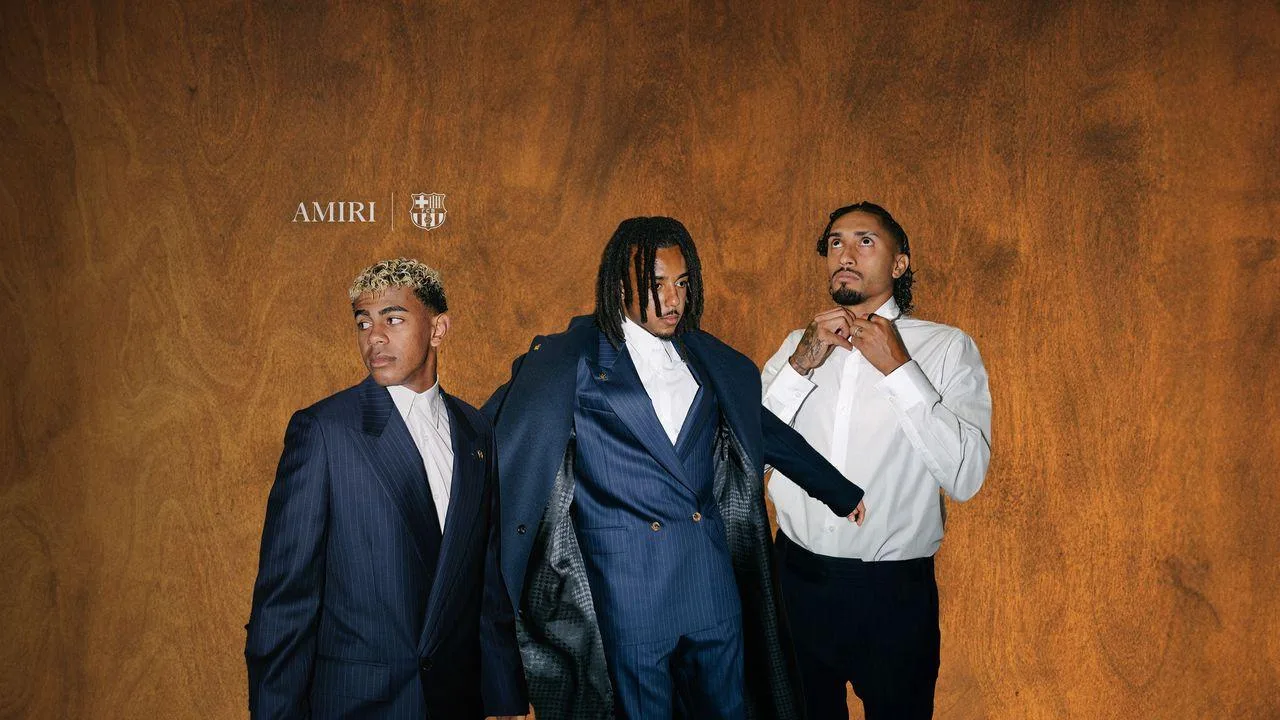
Football clubs can generate revenue beyond shirt advertising by leveraging their identity, reputation, and cultural significance.
According to the specialized sports economics platform, the second season of collaboration between luxury brand AMIRI and FC Barcelona is a significant example of business development in professional football. In this partnership, Mike Amiri, the Iranian-American designer and founder of AMIRI, has created exclusive official clothing for players and club managers. These products combine Barcelona’s visual identity with contemporary design and luxury tailoring.
This collaboration, which began in November 2025, is planned to last for five years, until the end of the 2029–2030 season. The second season’s collection was introduced in October 2026. Although the financial value of the contract has not been publicly disclosed, its economic importance lies in a model that combines sports branding, the fashion industry, and international marketing.
Football economics has evolved beyond advertising
In modern football, the commercial value of clubs is no longer limited to ticket sales, broadcasting rights, and placing sponsors’ names on jerseys. Leading global clubs have transformed their brand, players, history, colors, and fans’ emotional connection to the team into assets that can be leveraged across various markets.
According to the Deloitte Football Money League 2026 report, the world’s 20 most profitable football clubs generated a total revenue of 12.4 billion euros during the 2024–2025 season. Of this amount, 5.3 billion euros were earned from commercial activities, equivalent to about 43 percent of the clubs’ total revenue. Commercial revenue was also the largest source of income for the third consecutive year.
Deloitte attributes the growth of this sector to factors such as increased sponsorship revenue, improved product sales performance, and greater utilization of stadiums and club facilities on non-match days.
In this context, the collaboration between Barcelona and AMIRI should be analyzed as part of a broader strategy. By delegating the design and production of official clothing to a fashion brand, the club aims to create a connection between its sports identity and the lifestyle market. Meanwhile, the AMIRI brand gains access to the club’s global reputation and the media influence of its players.
The value of such a contract extends beyond its potential financial amount. Access to new audiences, media content production, brand enhancement, and opportunities for future collaborations are also crucial. However, these are potential benefits, and without the release of financial information, it is impossible to calculate the contract’s profitability.
What is the key lesson for Iranian football?
For Esteghlal and Persepolis clubs, the primary challenge is not copying Barcelona’s uniforms but learning how to transform the club’s identity into a product and generate income.
These two clubs possess valuable assets, including loyal fans, well-known logos, distinctive colors, a history of rivalry, popular players, and widespread media presence. Many businesses would require years of investment to build such assets. However, possessing these assets does not automatically guarantee effective economic exploitation of them.
A university study on Esteghlal and Persepolis’ revenue generation strategies highlighted the potential for media and advertising revenue, as well as commercial and managerial income. The study, which involved interviews with 12 experts and qualitative data analysis, showed that diversifying income could offset some of the limitations resulting from the weakness of traditional football revenue sources in Iran.
From this perspective, the development of clothing and licensed products businesses should be a core component of a club’s strategic plan, not a peripheral activity that is only noticed when a product is launched.
First proposal: Launch an official club clothing collection
Esteghlal and Persepolis clubs can create an exclusive collection of official clothing for their players, managers, and staff by collaborating with Iranian designers and reputable manufacturers.
This collection could include suits, single jackets, formal shirts, coats, bags, belts, and accessories bearing the club logo. Additionally, there is the possibility of designing everyday products such as T-shirts, hoodies, sweaters, and streetwear featuring the club’s visual identity.
The difference between this proposal and the production of ordinary clothing lies in creating a coherent design identity. Products must have an independent identity in terms of quality, price, packaging, and brand narrative, while also being clearly associated with the club.
For Esteghlal, the combination of blue and white colors and the modern use of the club’s historical symbols can serve as the foundation for design. For Persepolis, the red color, club logo, and historical heritage provide the potential to create a collection with a distinctive identity.
In the initial phase, it is advisable to offer a limited and experimental collection to determine demand levels, acceptable pricing, production costs, and profit margins. Production expansion should be based on actual sales results, not just estimates of fan numbers.
Second proposal: Collaborate with Iranian designers and brands
The collaboration between Barcelona and AMIRI demonstrates that a club does not necessarily need to develop all design and production capabilities in-house. Esteghlal and Persepolis clubs can also enter this market through partnership agreements with fashion designers, clothing brands, and leather product manufacturers. For example, each club could issue a call for proposals to select a designer or business partner. Designs would be evaluated based on quality, production capacity, price, sales program, intellectual property rights compliance, and financial offer.
In this model, the club can leverage the production and distribution capabilities of a business partner instead of investing heavily in factories, shops, and warehouses. In return, the partner benefits from a license to use the club logo and access to the fan market.
The partnership agreement should also specify each party’s share of sales, minimum financial guarantees, quality standards, license duration, reporting methods, online sales rights, and procedures for addressing counterfeit products.
Three contractual models can be considered in this regard:
- Fixed franchise fee: The business partner pays a specified amount for the license.
- Sales share: The club receives a percentage of the sales of licensed products.
- Combined model: A guaranteed minimum payment plus a share of sales.
The choice of an appropriate model should be based on sales forecasts, implementation costs, business risk, and the negotiating power of the parties involved.
Third proposal: Esteghlal and Persepolis, beyond official clothing
The potential market for fan products extends beyond ceremonial clothing. Therefore, these two clubs can create a portfolio of licensed products targeting different customer groups. These products could include bags, shoes, accessories, leather goods, stationery, collectibles, limited editions signed by players, and corporate gift packages.
For example, a collection titled “Club Heritage” could be launched to commemorate the club’s founding anniversary, championships, or to honor prominent players. The value of such products lies not only in their everyday use but also in their historical narrative, limited quantity, and authenticated originality, which can influence a fan’s purchasing decision.
However, collectibles and limited editions should be accompanied by real demand, authenticity control, and market-appropriate pricing. Additionally, producing expensive products without understanding fans’ purchasing power may lead to inventory accumulation and losses.
Fourth proposal: Direct sales to fans and creation of a customer club
One of the most significant commercial advantages of new collaborations is the ability to communicate directly with customers. Therefore, clubs should not limit their product sales capacity to intermediary stores or social media advertising.
In this regard, Esteghlal and Persepolis clubs can offer licensed products to fans by establishing an official online store or enhancing existing platforms. Additionally, a fan membership program can provide services such as purchase discounts, early access to new collections, member-exclusive products, and special offers from business partners.
For this model to succeed, order registration, payment, delivery, return processing, and support must be reliable. Customer information should also be stored with respect for privacy and security requirements.
It is important to note that a customer club gains economic value when it leads to increased repeat purchases, better understanding of demand, and improved long-term relationships between the club and its fans, rather than merely serving as a system for user registration.
Fifth proposal: Establish an independent unit for product development and commercial licensing
To implement such a program, it is recommended that each club establish a specialized unit to manage licensed products and brand business development. The responsibilities of this unit could include selecting business partners, reviewing product designs, issuing licenses, quality control, sales management, trademark protection, and evaluating contract performance.
If economically and legally justified, the creation of a specialized company or collaboration with a business development firm could also be considered. However, establishing a new structure does not automatically generate income. First, the business model, target market, costs, and executive responsibilities must be defined.
Conclusion
The collaboration between Barcelona and AMIRI serves as an example of commercial management of club identity for Iranian football, rather than a model for clothing design. Esteghlal and Persepolis can leverage their social and cultural capital to develop the market for fan products and exclusive clothing, thereby realizing part of their brand’s economic potential.
However, the success of such a program does not depend solely on the number of fans. Purchasing power, customer trust, product quality, proper distribution, combating counterfeit goods, transparent contracts, and professional management determine how much of the club’s reputation can be converted into real income.
The final recommendation is that Esteghlal and Persepolis, instead of launching multiple expensive projects simultaneously, each start with a limited experimental collection of licensed clothing and products. After assessing sales and profitability, this activity can be expanded into a regular, long-term business.
It is worth noting that “in football economics, a brand becomes a profitable asset when it transforms from a popular name into a collection of reputable products, a suitable shopping experience, and a stable relationship with customers.”
Mehdi Hajivand, Sports Economics Expert
End of message.